Champakali Haar in 22K Gold
22K सोने का चम्पकली हार: फूलों की माला, सोने में ढली
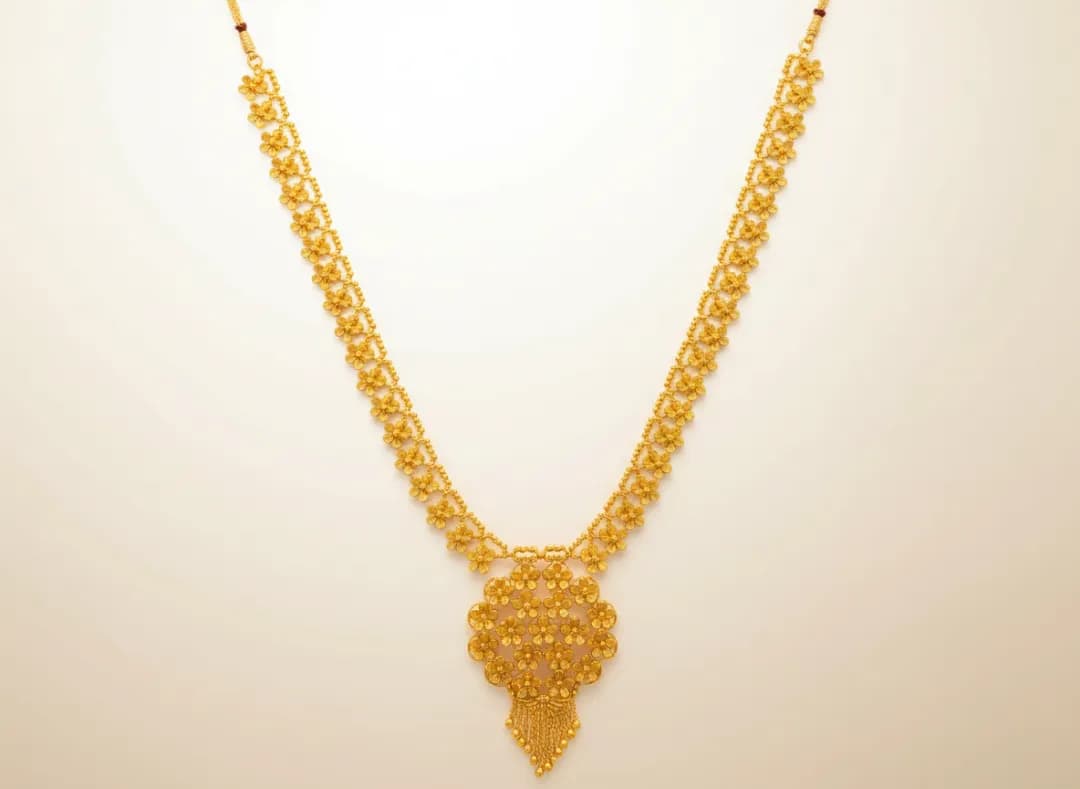
Every flower on this haar tells a story older than memory itself. Inspired by the champakali: the bud of the sacred champa flower that has adorned Indian royalty and brides since the Peshwa courts, this 22K gold floral haar necklace is a wearable garland of individually crafted golden blooms. Each six-petal flower link is die-stamped and hand-finished, connected in a continuous chain that drapes like a fresh champa mala around your neck, culminating in a dramatic floral cluster pendant with delicate jhalar tassels. BIS hallmark certified.
Product Details
Metal
22K Yellow Gold
Purity
916 (91.67% Pure)
Certification
BIS Hallmark + HUID
Design
Champakali Floral
What You See in This Haar
| Metal & Purity | 22K (916) Yellow Gold: 91.67% pure |
| Weight Range | Approx. 20-45+ grams (varies by length and density) |
| Design Style | Champakali (Champa Flower Bud): Traditional Indian Floral Haar |
| Chain Construction | Individual flower links, die-stamped & hand-assembled |
| Pendant | Floral cluster dome with jhalar (gold tassels/fringes) |
| Finish | Satin-polished yellow gold with hand-finished flower petals |
| Certification | BIS Hallmark with HUID (Bureau of Indian Standards) |
| Length | Long haar: approx. 22-30 inches (customisable) |
| Suitable For | Weddings, bridal trousseau, Dhanteras, Akshaya Tritiya, festivals, heirloom gifting |
| Gender | Women |
| Packaging | Swarnshikhar branded box with velvet pouch, certificate, and care card |
| Available At | Swarnshikhar Jewellers, Chembur, Mumbai: also available via WhatsApp order |
The Sacred Champa FlowerWhy This Design Endures
The champakali haar is not a modern invention. It is a design rooted in centuries of Indian devotion to the champa flower, the Magnolia champaca, a fragrant, golden-petalled blossom revered across Hindu, Buddhist, and Jain traditions as a symbol of purity, fertility, and divine grace. In classical Sanskrit poetry, the champa is called “the king of flowers” for its intoxicating fragrance and elegant form.
Krishna's Garland: The Bhagavata Purana Connection
In the Bhagavata Purana, Lord Krishna is described adorned with garlands of champaka, parijata, and tulsi, flowers offered by devotees as expressions of the highest bhakti. The champa garland on Krishna's chest is a recurring image in Vaishnava iconography. When you drape a champakali haar around your neck, you are wearing the same motif that has adorned the divine for millennia, a garland cast in imperishable gold.
The Maharashtrian Bridal Tradition
In Maharashtrian weddings, the champakali haar has been a bridal staple since the Peshwa era (18th century). The Marathi bride traditionally wears it alongside the Kolhapuri Saaj, Thushi choker, and Mohan Mala: each piece carrying the family's legacy and values. The champakali haar is often passed down from mother to daughter-in-law, so it carries family memory as much as gold weight. The flower motif represents fertility, prosperity, and the blossoming of a new household.
Pan-Indian Heritage: From Temples to Trousseau
The floral haar tradition extends far beyond Maharashtra. In South Indian temple jewelry, flower-link necklaces are used to adorn deity murtis during festivals, the gold garland serving as a permanent offering. Rajasthani and Gujarati brides wear their own variants, often enhanced with meenakari enamel work on the reverse of each flower. The champakali form: small, individually crafted flower buds linked into a continuous chain, is one of the oldest and most widespread designs in the Indian goldsmith's repertoire.
What the Champa Flower Represents
In Indian culture, flowers are not mere decoration. They carry specific spiritual meanings. The champa (Magnolia champaca) holds a unique place because it is considered too sacred to offer casually; it must be offered with intention.
Devotion & Purity
The champa's golden colour and sweet fragrance make it one of the pancha-pushpa (five sacred flowers) offered in Hindu puja. It symbolises the devotee's pure intention, just as the flower releases its fragrance selflessly, the devotee offers love without expectation.
Fertility & Prosperity
Across South and Southeast Asia, the champa is associated with fertility and the abundance of new life. This is why champakali jewelry is traditionally gifted to brides. It carries the blessing of a fruitful, prosperous household. The tree itself is evergreen, a sign of lasting vitality.
Warding Off Negativity
In traditional belief, champa flowers possess the power to repel evil spirits and negative energies. This protective quality transfers to jewelry bearing the champa motif, so a champakali haar is worn as spiritual protection as well as ornament.
The Champa in Literature:
“Champaka-pushpa-bhushitam”
“Adorned with champaka blossoms”, a recurring epithet for Krishna in Vaishnava poetry
Craftsmanship & Artistry
From raw 22K gold sheet to a garland of golden flowers: every link is shaped, finished, and joined by hand
Die-Stamping Each Flower Link
Each flower on this haar begins as a thin sheet of 22K gold. A karigar (artisan) places it on a specially engraved steel die, a negative mould of the six-petal champa bud, and stamps it with a precise hammer blow. The force transfers the flower pattern onto the gold, creating a three-dimensional petal structure with crisp edges and uniform depth. This technique, called die-stamping or chaap, has been used by Indian goldsmiths for centuries. It produces consistent, lightweight flower units that would be too delicate for casting.
Hand-Assembly & Linking
After stamping, each flower link is individually trimmed, smoothed, and fitted with tiny loops on either side. A master assembler then connects the flowers one by one into a continuous chain, threading fine gold wire through the loops and soldering each joint. This is the most painstaking step: a single haar can contain 60 to 120 individual flower links, each requiring precise alignment so the chain drapes evenly without twisting or bunching. The result is a necklace that moves like a living garland.
The Central Pendant: Floral Cluster & Jhalar
The dramatic centrepiece is where the goldsmith's skill truly shines. Multiple flower motifs are layered and soldered into a dome-shaped cluster, each flower at a slightly different angle to create depth and dimension. Below the cluster, delicate jhalar tassels are attached: thin gold wires with tiny bead-like tips that sway with the wearer's movement, adding kinetic beauty. The jhalar is a hallmark of traditional Indian haar design, it symbolises abundance and grace, and its gentle movement catches light from every angle.
22K Gold: The Warm, Rich Standard
At 91.67% pure gold, 22K has been the preferred purity for Indian bridal and temple jewelry for centuries. It carries the deep, warm yellow tone that devotees and brides associate with auspiciousness, a colour that 18K and 14K gold simply cannot replicate. The remaining 8.33% is copper and silver alloy, adding just enough strength for the delicate flower links to hold their shape through years of wear. Every piece is BIS hallmark certified with a unique HUID number, our guarantee of purity and traceability.
Perfect Occasions to Gift or Wear
A gold floral haar is a gift of lasting beauty: cherished across generations and worn on the moments that matter most
Wedding & Bridal Trousseau
The champakali haar is a cornerstone of the Indian bridal trousseau, traditionally gifted by the bride's family as part of her streedhan (woman's wealth). In Maharashtrian weddings, it is worn alongside the Kolhapuri Saaj and Thushi choker. In North Indian weddings, it pairs beautifully with a polki choker and raani haar set. It is the piece the bride will wear again and again, at karva chauth, teej, and every anniversary.
Dhanteras & Akshaya Tritiya
Dhanteras: the first day of Diwali, sacred to Goddess Lakshmi and Lord Kubera, is the most auspicious day in the Hindu calendar to buy gold. Akshaya Tritiya (April-May) is the day when nothing diminishes; gold purchased on this day is believed to grow perpetually. A champakali haar bought on either day carries the dual blessing of material prosperity (Lakshmi) and eternal beauty (the imperishable champa garland).
Godh Bharai & Baby Shower
In Indian tradition, the mother-to-be is showered with gold during her godh bharai (baby shower) as a blessing for both mother and child. A floral haar, with its symbolism of fertility, blossoming, and new life, is one of the most meaningful gifts for this occasion. It becomes part of the family's jewelry legacy, eventually passed down to the child on their own wedding day.
Navratri & Durga Puja
The nine nights of Navratri celebrate the divine feminine: Goddess Durga in her nine forms. Women dress in their finest jewelry for garba, dandiya, and the pandal visits. A gold floral haar adds grandeur to a silk saree or chaniya choli without overwhelming the look. In Bengali Durga Puja traditions, gold jewelry is worn on Ashtami and Navami as an offering of beauty to the Goddess.
Karva Chauth & Wedding Anniversary
Karva Chauth: the day a wife fasts for her husband's long life, is one of the most jeweled occasions in North Indian tradition. A gold haar gifted on this day carries deep emotional significance. For wedding anniversaries, a champakali haar says what words cannot: that the garland of your togetherness lasts as long as the gold does.
Griha Pravesh & Housewarming
When a family enters a new home, the woman of the house traditionally crosses the threshold wearing her finest gold. It is believed to invite Lakshmi into the dwelling. A gold haar worn during griha pravesh, or gifted to a daughter or daughter-in-law entering her new home, is a blessing of prosperity, beauty, and abundance for the household.
The Golden Garland: A Tradition in Gold
The phool haar, the flower garland necklace, predates the Mughal era and finds its earliest echoes in Harappan jewelry unearthed from Mohenjo-daro, where gold beads shaped like flower buds were strung into necklaces over 4,000 years ago. The idea was always the same: take the most beautiful thing in nature, a flower, and make it eternal by casting it in the most incorruptible metal on earth.
In the courts of the Peshwas in 18th-century Pune, this tradition reached its artistic peak. Marathi goldsmiths, the Sonars of Kolhapur and Pune, developed the champakali form that this haar inherits: small, individually stamped champa buds linked into flowing chains that moved with the body like a living garland. The bride who wore a champakali haar was not simply wearing jewelry, she was wearing the garden of the gods around her neck, a garland that would never wilt, never lose its fragrance, never fade.
What makes this design remarkable is its balance of visual richness and physical lightness. Each flower link is hollow-stamped from thin gold sheet, not solid, which means even a long haar of 80 to 120 flowers remains comfortable for all-day wear. The jhalar tassels at the pendant add movement and sound, a quiet, golden jingle that traditional Indian aesthetics prize as a marker of grace. In Sanskrit, this quality is called “nupura-dhvani”: the music of ornament.
When you hold this haar in your hands, you are holding a design that connects the Harappan goldsmith to the Peshwa court jeweler to the karigar who shaped these very flowers. Four thousand years of Indian goldwork, distilled into a single necklace. That is the inheritance you wear.
Care Instructions
22K Gold Cleaning
Wipe gently with a soft lint-free cloth after each wear to remove body oils and sweat that accumulate between the flower petals. For deeper cleaning, soak the haar in lukewarm water with a drop of mild dish soap for 10-15 minutes. Use a very soft baby toothbrush to gently clean the crevices between individual flower links. Pat dry with a clean cloth, ensure no moisture is trapped between the petals, as this can cause dulling over time. Never use commercial gold polish, toothpaste, or baking soda on 22K gold.
What to Avoid
22K gold is softer than lower-karat gold due to its higher purity, the delicate flower links can bend if snagged on fabric or pulled roughly. Always put the haar on last, after dressing, applying makeup, perfume, and hairspray. Remove before bathing, swimming (chlorine is especially damaging), cooking, and any physical activity. Avoid contact with household chemicals, bleach, and detergents. Do not hang the haar on a hook, the weight concentrated on the clasp can stretch the links over time.
Storage & Professional Care
Store flat in the velvet pouch provided: laying it flat prevents kinking and distributes weight evenly across the flower links. Keep in a cool, dry place; add a silica gel packet to the storage box if humidity is a concern. Store separately from other jewelry to avoid scratching. For professional ultrasonic cleaning, polishing, or clasp repair, visit our Chembur store, we offer complimentary cleaning for all Swarnshikhar pieces and will inspect the solder joints while we're at it.
Frequently Asked Questions
This haar is crafted in 22K (916) yellow gold: 91.67% pure gold, the traditional standard for Indian bridal and festive jewelry. The high purity gives the piece its characteristic rich, warm yellow colour that lower-karat gold cannot match. Every piece carries a BIS hallmark with a unique HUID (Hallmark Unique Identification) number, traceable to the exact purity, maker, and assaying centre.
Explore Our Necklace Collection
Gold haars, champakali necklaces, bridal sets, chokers, and more, all BIS hallmark certified at Swarnshikhar Jewellers, Chembur.
40+ Years Serving Mumbai
Trusted by thousands of families across Mumbai since 1986.
3 Generations Family Legacy
Three generations of the Jain family have run this shop since 1986.
BIS Hallmark Certified Purity
Every silver and gold item comes with BIS hallmark guarantee of purity.
Talk to Us - We Reply Within the Hour
WhatsApp is fastest. Or fill this form and we'll call you back.
Our Guarantees
Authenticity Guarantee
Every piece comes with certification. Gold is BIS hallmarked, diamonds include IGI or GIA certificates.
Craftsmanship Guarantee
Our master craftsmen back every piece with a lifetime craftsmanship guarantee. If anything loosens or breaks under normal wear, we fix it free.
Timely Delivery
Custom orders delivered on the agreed date, with WhatsApp updates as your piece takes shape.
Transparent Pricing
Making charges, wastage, and final price - all explained upfront before you decide. No hidden costs.
"We've been serving Mumbai families since 1986. Every customer who walks through our door is family."
- Pukhraj Jain, Founder