Gold Gundla Mala Necklace with Temple Pendant
22K सोने का गुंडला माला: परंपरागत मंदिर पेंडेंट के साथ
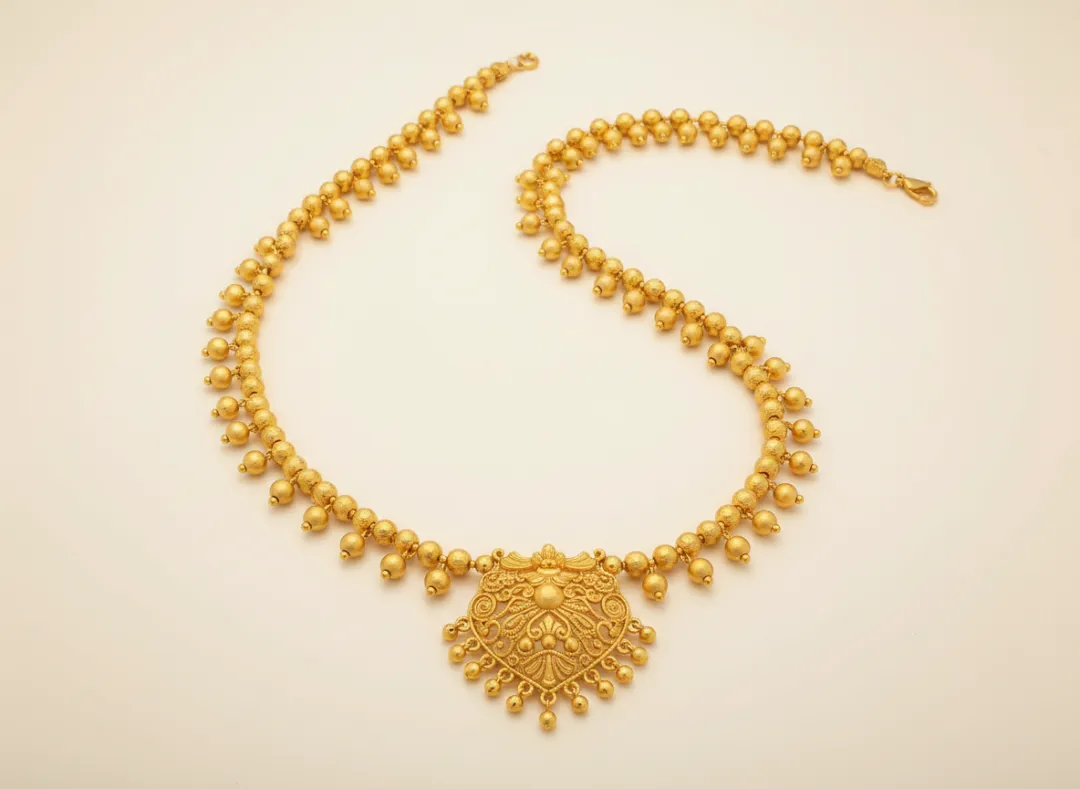
Some pieces of jewelry carry more than beauty. They carry the memory of every celebration, every temple visit, every silk saree that your mother and grandmother wore before you. This gold gundla mala necklace, with its graduated round beads catching the light and an ornate temple pendant resting at its heart, is one of those pieces. Crafted in rich 22K gold with a high-polish finish, every bead is formed to perfection, and the traditional pendant carries filigree work with floral temple motifs and delicate dangling gold beads that sway with grace. BIS hallmark certified with HUID.
Product Details
Metal
22K Yellow Gold
Purity
916 (91.67% Pure)
Certification
BIS Hallmark + HUID
Style
Gundla Mala
What You See in This Necklace
| Metal & Purity | 22K (916) Yellow Gold: 91.67% pure |
| Finish | High polish on beads, detailed textured finish on pendant |
| Design Style | Traditional South Indian Gundla Mala: Temple Jewelry |
| Necklace Type | Graduated gold bead chain (gundla/gundu mala) with pendant |
| Pendant Motifs | Floral temple design with filigree, granulation, and dangling gold beads |
| Craftsmanship | Handcrafted: die-stamped beads, hand-assembled chain, filigree pendant |
| Certification | BIS Hallmark with 6-digit HUID (Bureau of Indian Standards) |
| Suitable For | Weddings, Varalakshmi Vratham, Dhanteras, festivals, temple visits, gifting |
| Gender | Women: pairs beautifully with silk sarees, lehengas, and traditional attire |
| Customisation | Available: weight, length, pendant design, bead size (3-5 weeks) |
| Packaging | Swarnshikhar branded box with soft pouch, hallmark certificate, and care card |
| Available At | Swarnshikhar Jewellers, Chembur, Mumbai: also available via WhatsApp order |
The Gundla MalaA Living Thread of South Indian Heritage
The gundla mala is a cultural inheritance. In Telugu, “gundla” means round and “mala” means garland of beads. For centuries, this form of gold bead necklace has been the cornerstone of South Indian bridal jewelry, passed down from mother to daughter as part of the streedhan, the bride's personal wealth that belongs to her alone. When a woman wears her gundla mala, she carries her family's story in every bead.
Royal Origins: Chola & Vijayanagara Empires
Gold bead necklaces appear in temple sculptures from the 9th century Chola dynasty onwards, adorning goddesses and queens alike. Under the Vijayanagara empire (14th-17th century), Krishnadevaraya's court elevated South Indian goldsmithing to an art form: the gundla mala became a marker of aristocratic status and temple patronage. The graduated bead design, where beads grow larger toward the centre, mirrors the temple gopuram (tower) aesthetic, broadest at the base, tapering toward the divine.
The Symbolism of the Round Gold Bead
In Indian tradition, the sphere is the most perfect shape, without beginning or end, symbolising wholeness, infinity, and the cycle of life. Each gold bead in a gundla mala represents this completeness. The graduated arrangement, small beads near the clasp growing larger toward the pendant, symbolises the growth of prosperity and the accumulation of blessings through a woman's life. The pendant at the centre is the focal point of devotion, traditionally featuring temple motifs that connect the wearer to the divine.
Streedhan: A Woman's Own Wealth
In Hindu tradition, streedhan (literally “woman's wealth”) refers to the gold and jewelry given to a bride at marriage that remains exclusively hers, it cannot be claimed by the husband's family. The gundla mala, often one of the most valuable pieces in a bride's collection, represents financial security, family honour, and the continuation of a matrilineal tradition of gold ownership that has empowered Indian women for millennia.
The Temple Pendant: More Than Decoration
The pendant on this gundla mala draws on South Indian temple jewelry: ornaments originally created to adorn deity idols in temples across Tamil Nadu, Andhra Pradesh, Karnataka, and Kerala. Over centuries, these sacred designs transitioned from temple offerings to personal adornment, carrying their spiritual significance with them.
Filigree Work: Threading Gold into Lace
The patterns on the pendant are created through filigree, the ancient art of twisting and curling hair-thin gold wires into ornamental designs. This technique, perfected in Karimnagar (Telangana) and Cuttack (Odisha), gives the pendant its characteristic delicate, lace-like appearance while maintaining structural strength.
Granulation: Tiny Spheres, Immense Skill
The textured surface of the pendant uses granulation: the technique of fusing tiny gold spheres (granules) onto the surface to create patterns and texture. This art dates back to the Etruscan civilization and was independently mastered by Indian goldsmiths. Each granule is placed individually and fused using controlled heat, no solder visible to the eye.
Floral Temple Motifs
The floral patterns on the pendant echo the lotus (padma), the sacred flower associated with Goddess Lakshmi, the deity of wealth and prosperity. In temple iconography, the lotus represents purity arising from muddy waters, divine beauty, and spiritual awakening. Wearing lotus motifs close to the heart is believed to invite Lakshmi's blessings into one's life.
Lakshmi Mantra:
ॐ श्रीं ह्रीं श्रीं कमले कमलालये प्रसीद
Chant while wearing the necklace to invoke Lakshmi's blessings of prosperity
Craftsmanship & Artistry
From raw 22K gold to a necklace worthy of your family's legacy, every step is done by hand
Die-Stamped Gold Bead Formation
Each gold bead begins as a thin sheet of 22K gold, precision-rolled to the exact thickness. The sheet is pressed into a specially designed die using a controlled hammer strike, creating two half-spheres that are then joined and fused to form a round bead with no visible seam. This die-stamping technique, used in Indian goldsmithing for centuries, ensures each bead is perfectly round and uniform in size. The graduated sizing, smaller near the clasp, larger near the pendant, requires multiple die sets and careful sorting by the karigar (artisan).
Hand-Threaded Assembly
Unlike machine-made chains where beads are strung on a wire in seconds, a traditional gundla mala is hand-assembled. Each bead is threaded onto a gold core wire in the precise graduated sequence, the artisan tests the drape and weight balance at each stage. The smaller dangling beads along the sides are individually attached using tiny gold loops, each soldered by hand. This assembly process takes an experienced karigar several hours for a single necklace. Done well, the piece drapes naturally and lies flat against the chest.
Temple Pendant: Filigree & Repoussé
The pendant is crafted using a combination of two ancient techniques. The base form is shaped through repoussé, hammering the gold from the reverse side to create the raised relief of the floral motif. The surface patterns are then added through filigree, hair-thin gold wires twisted, curled, and soldered into the decorative framework. The final step is granulation: tiny gold spheres are individually placed and fused to the surface using precise heat control. This trio of techniques, repoussé, filigree, and granulation, is the signature of South Indian temple jewelry.
22K Gold: The Indian Standard of Trust
At 91.67% pure gold, 22K carries the warm, deep yellow tone that generations of Indian families associate with real gold. Lower purities like 18K (75%) and 14K (58.5%) simply cannot match this warmth, they appear paler and lack the richness that makes Indian gold jewelry distinctive. Every piece from Swarnshikhar carries a BIS hallmark with a unique 6-digit HUID number, verifiable through the government's BIS Care app. This is our non-negotiable promise to you, the gold is exactly what we say it is.
Perfect Occasions to Gift or Wear
A gold gundla mala is a gift of heritage and prosperity: cherished across generations and celebrations
Weddings & Bridal Jewelry
The gundla mala is an essential part of the traditional South Indian bridal ensemble, especially in Telugu weddings. Paired with a Kanjeevaram silk saree, it is what most Telugu brides wear at the muhurtham. As part of the streedhan, it is one of the most meaningful pieces a mother can gift her daughter, a tangible symbol of family love, financial security, and cultural continuity that will be worn for decades and passed to the next generation.
Varalakshmi Vratham
Observed on the second Friday of the Shravana month (July-August), Varalakshmi Vratham is a puja dedicated to Goddess Lakshmi performed by married women seeking blessings of prosperity for their families. Gold jewelry, especially necklaces with Lakshmi or lotus motifs, is worn and offered during this puja. A gundla mala with a temple pendant is among the most fitting pieces for this occasion, honouring the goddess who embodies wealth, grace, and family well-being.
Dhanteras & Akshaya Tritiya
Dhanteras (the first day of Diwali, October-November) and Akshaya Tritiya (April-May) are the most auspicious days to buy gold in the Hindu calendar. “Akshaya” means “never diminishing”, gold purchased on this day is believed to multiply and bring lasting prosperity. A gundla mala bought on either occasion carries the double blessing of a sound gold investment and a beautiful piece of heritage jewelry your family will treasure.
Griha Pravesh (Housewarming)
When a family enters a new home, the woman of the house traditionally wears her finest gold jewelry as she crosses the threshold, inviting Lakshmi (prosperity) into the new space. A gundla mala gifted for a griha pravesh is both a blessing and a practical expression of care. It says: “May this home always know abundance, and may you always have something precious that is yours alone.”
Godh Bharai & Baby Showers
In many Indian families, the expectant mother's parents gift gold jewelry during the godh bharai (baby shower) ceremony, a tradition of ensuring the mother has personal wealth as she enters a new chapter of life. A gundla mala is a deeply thoughtful choice for this occasion: substantial enough to be a meaningful investment, beautiful enough to be worn with pride at family celebrations, and traditional enough to one day become part of the child's own heritage.
Milestone Birthdays & Anniversaries
For a woman who loves traditional gold jewelry, few gifts carry more meaning than a handcrafted gundla mala. Whether for a 40th birthday, a 25th wedding anniversary, or a retirement celebration. This is a gift that says “I see you, I honour your journey, and I want you to have something that lasts.” Unlike trendy fashion jewelry that falls out of style, a gundla mala grows more precious with every year and every memory attached to it.
Why Indian Families Choose Gold Bead Necklaces
For Indian families, gold is financial security and cultural identity as much as adornment. India is the world's largest consumer of gold jewelry, and this is not a modern phenomenon. It is a tradition stretching back over 5,000 years to the Harappan civilisation, where some of the earliest known gold beads have been excavated by archaeologists. The round gold bead, in its simplicity, has endured through empires, invasions, and modernisation because its appeal is universal: it is beautiful, it is valuable, and it carries meaning.
In South India specifically, the gundla mala occupies a unique position. Unlike the more elaborate and heavy bridal necklaces that are worn once and kept in a locker, a well-designed gundla mala is versatile enough to be worn to weddings, temple visits, family celebrations, and even paired with a simple silk saree for a festive lunch. This practicality, combined with its cultural weight, is what makes it one of the most requested designs in traditional jewelry stores across Andhra Pradesh, Telangana, Tamil Nadu, and Karnataka: and now, right here at Swarnshikhar in Chembur, Mumbai.
When you hold this necklace in your hands and feel the weight of each gold bead, you are holding something that connects you to a tradition that has lasted millennia. It is a piece of your culture, made in the purest gold, certified by the government, and finished by a jeweller who has served families here for 40 years.
Care Instructions
Gold Bead Cleaning
22K gold beads are softer than lower-carat gold and need gentle handling. After each wear, wipe the entire necklace with a soft lint-free cloth to remove body oils and sweat that can dull the polish. For deeper cleaning, soak in lukewarm water with a drop of mild liquid soap for 5 minutes, then use a very soft brush (baby toothbrush works well) to clean between the beads where dirt accumulates. Rinse under clean water and pat dry completely. Never use abrasive cleaners, baking soda, vinegar, or toothpaste.
Pendant Care
The temple pendant has filigree and granulation work with tiny crevices that can trap oils and dust. Clean gently with a soft brush, paying attention to the detailed areas. The pendant's raised surfaces may develop a warm patina over time. This is natural and many owners prefer this aged look. If you prefer a bright finish, a professional ultrasonic cleaning will restore it. Avoid pressing or bending the filigree elements. They are delicate by design. For any repair or re-polishing, visit us at our Chembur store.
Storage & Wear Tips
Store in the soft pouch provided, laid flat: never hang a gold bead necklace, as the weight can stretch the threading over time. Keep separate from other jewelry to avoid scratches. Put the necklace on last, after applying perfume, makeup, and lotions, as chemicals accelerate tarnishing. Remove before bathing, swimming (chlorine is gold's worst enemy), or heavy physical activity. Rotate wear across your collection to reduce stress on any one piece. For professional cleaning, re-stringing, or repair, we're always happy to help at our Chembur store.
Frequently Asked Questions
Gundla mala (also called gundla haram or gundu mala) literally means 'round beads necklace' in Telugu. It is one of the most treasured forms of traditional South Indian gold jewelry, originally associated with royalty and temple offerings during the Chola and Vijayanagara empires. The necklace features graduated round gold beads that symbolise wholeness, continuity, and prosperity. In Telugu bridal tradition, the gundla mala is an essential part of the streedhan (bridal wealth) and is passed down through generations. Today it is worn across South India during weddings, poojas, and festive occasions as a symbol of heritage and family legacy.
Explore Our Necklaces Collection
Gold gundla malas, temple necklaces, chokers, rani haars, and more, all BIS hallmark certified at Swarnshikhar Jewellers, Chembur.
40+ Years Serving Mumbai
Trusted by thousands of families across Mumbai since 1986.
3 Generations Family Legacy
Three generations of the Jain family have run this shop since 1986.
BIS Hallmark Certified Purity
Every silver and gold item comes with BIS hallmark guarantee of purity.
Talk to Us - We Reply Within the Hour
WhatsApp is fastest. Or fill this form and we'll call you back.
Our Guarantees
Authenticity Guarantee
Every piece comes with certification. Gold is BIS hallmarked, diamonds include IGI or GIA certificates.
Craftsmanship Guarantee
Our master craftsmen back every piece with a lifetime craftsmanship guarantee. If anything loosens or breaks under normal wear, we fix it free.
Timely Delivery
Custom orders delivered on the agreed date, with WhatsApp updates as your piece takes shape.
Transparent Pricing
Making charges, wastage, and final price - all explained upfront before you decide. No hidden costs.
"We've been serving Mumbai families since 1986. Every customer who walks through our door is family."
- Pukhraj Jain, Founder