Gold Mango Mala Necklace
मैंगो माला, परंपरागत दक्षिण भारतीय स्वर्ण हार
There is a reason the mango shape has adorned the necks of South Indian women for over a thousand years. It is a prayer pressed into gold, a wish for abundance that has passed from mother to daughter since the days of the Chola empire. Each mango pendant is individually crafted in 22K BIS-hallmarked gold, shaped using traditional die-pressing techniques, and finished to catch warm light at every angle.
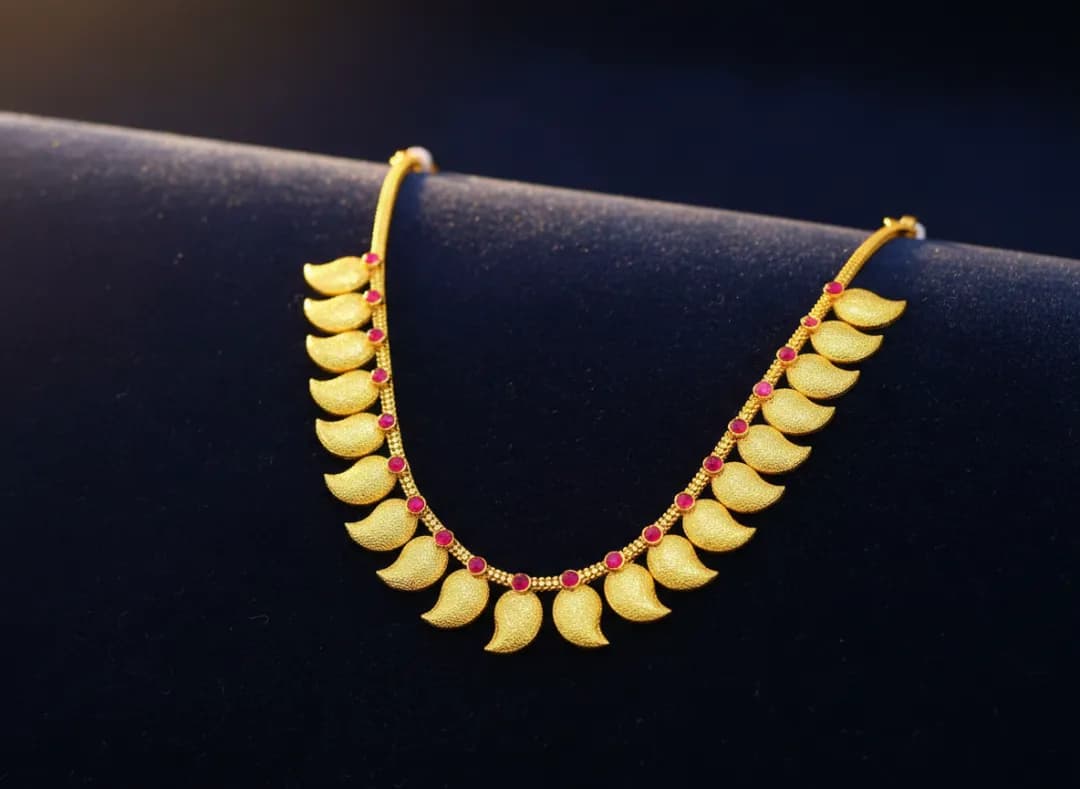
Product Details
Metal
22K (916) Gold
Motif
Mango / Paisley
Design Style
South Indian Temple
Certification
BIS Hallmarked
Detailed Specifications
Hold a mango mala in your hands and you will understand why this design has survived a thousand years. Each pendant is shaped like the kairi, the unripe mango, a form so ancient that it appears carved into the pillars of the Brihadeeswara Temple in Thanjavur, woven into Kanchipuram silk, and painted onto the palms of brides across Tamil Nadu and Kerala. When the Chola queens wore their manga malai to temple, they wore the same shape you see here today: a teardrop curve with a pointed tip, like a seed that holds within it the promise of an entire orchard. This is not jewellery that follows fashion. It is jewellery that fashion has spent centuries trying to imitate.
At Swarn Shikhar, we craft each mango pendant in 22K hallmarked gold using die-pressing, a technique where a hardened steel die stamps the mango form into a gold sheet under controlled pressure, producing a pendant with crisp edges, uniform depth, and the smooth, slightly convex surface that catches light like a polished river stone. After pressing, each pendant is hand-finished: the edges are filed smooth, the surface is polished to a warm lustre, and every piece is individually inspected before being linked onto the chain. The result is a necklace where each mango pendant is identical in proportion yet carries the subtle warmth of handwork, the kind of quality you feel in your fingers before you see it in a mirror.
We have been serving families in Chembur and across Mumbai for over 40 years, and a mango mala is rarely bought as an ornament. It is the necklace a mother puts around her daughter's neck before the wedding mandap. It is the first piece of gold a young woman receives from her in-laws, heavy with expectation and blessing. It is the heirloom that arrives in a velvet pouch on Dhanteras, carrying the scent of sandalwood and the weight of generations. That is why every mango pendant that leaves our store is hallmarked, weighed, and finished to a standard that we would trust for our own family.
The Sacred Mango MotifA Thousand Years of Meaning
The mango: called ambi in Punjabi, kairi in Hindi, and manga in Tamil and Malayalam: is one of the most sacred fruits in Hindu culture. Every part of the mango tree is considered auspicious: its leaves are strung into torans (door garlands) at weddings and festivals, its wood fuels the sacred havan fire, and its fruit symbolises Kamadeva, the god of love. In the Atharva Veda, the mango is described as a symbol of abundance and fertility, offered to the gods during harvest rites. When goldsmiths shaped the first mango pendant over a thousand years ago, they were not creating a decorative pattern. They were pressing a prayer into metal.
The paisley form, that graceful teardrop curve with a bent tip, traveled from Mughal India along the Silk Road to Persia, where it was called boteh jegheh (cluster of leaves), and eventually to the weaving mills of Paisley, Scotland, where it acquired the name the West knows it by today. But long before the British East India Company shipped Kashmir shawls to Europe, the mango shape was being hammered into gold in the temples of Thanjavur. During the Chola dynasty (9th-13th century CE), the manga malai was worn by queens, temple dancers (devadasis), and deity idols alike, a necklace that connected the human world to the divine.
In Uttarakhand's Aipan ritual art, women draw mango-shaped curves in white rice paste on red ochre floors as invitations to Goddess Lakshmi: the shapes echo the swelling belly of a ripe mango, representing fullness and prosperity. In Warli tribal murals of Maharashtra, mango trees stand at the centre of fertility dances. When you wear a mango mala, you carry these meanings close to your heart: abundance, fertility, divine grace, and the unbroken thread of Indian artistic tradition.
What the Mango Shape Represents
Fertility & New Life
The kairi (unripe mango) shape represents the seed of potential, the beginning of new life. In Indian wedding traditions, the mango motif appears on mehendi, on the bride's saree, and on her jewellery as a collective blessing for fruitfulness and a prosperous married life. It is the symbol most closely associated with the divine feminine.
Prosperity & Abundance
The mango tree yields fruit in abundance year after year. It is one of the longest-producing fruit trees in India. Wearing the mango shape in gold is a wish for ever-renewing wealth, not the kind that comes and goes, but the kind that deepens with each generation. Azva's bridal jewellery features seven paisley motifs representing the seven vows (saptapadi) of a Hindu wedding.
Eternity & Continuity
In Persian tradition: where the paisley is called boteh, the bent tip of the shape represents the flame of Zoroastrianism or the cypress tree, both symbols of eternal life. In India, the mango's evergreen nature (the tree lives for 300+ years) makes it a symbol of unbroken continuity, the perfect motif for jewellery meant to be passed from mother to daughter across generations.
Love & Devotion
The mango is sacred to Kamadeva, the Hindu god of love, whose bow is said to be made of sugarcane strung with a chain of bees and tipped with five mango-blossom arrows. A gold mango mala gifted by a husband or mother-in-law carries the unspoken wish: may your life be as sweet and abundant as the fruit itself.
Craftsmanship & Quality
Die-Pressed Mango Pendants
Each mango pendant is formed using a hardened steel die that stamps the paisley shape into a sheet of 22K gold under controlled pressure. This die-pressing technique, used in South Indian temple jewellery for generations: produces pendants with perfectly uniform dimensions, crisp edges, and a smooth, slightly convex surface that catches light beautifully. The die itself is hand-cut by a master tool-maker, so the teardrop form stays true to the Chola-era originals.
Hand-Finished Edges & Polish
After die-pressing, each pendant is individually hand-finished: the edges are filed to remove any burrs from the stamping process, the surface is buffed to a warm, high-polish lustre using graduated polishing wheels, and the connecting loops are soldered and smoothed so they sit flat against the chain. This combination of machine precision and hand-finishing is what distinguishes artisanal temple jewellery from mass-produced alternatives, you get the consistency of die-pressing with the warmth and attention of handwork.
BIS Hallmarked: Every Component
Every gold component in this necklace: the mango pendants, the chain links, and the clasp mechanism, is BIS hallmark certified with a 6-digit HUID (Hallmark Unique Identification) number that you can verify on the government's BIS Care app. Hallmarking has been mandatory across India since June 2021, but at Swarn Shikhar we have been hallmarking every piece since well before the mandate. That is 40 years of the same practice.
Available in Polished or Matte Finish
This mango mala comes in a high-polish finish that delivers dazzling radiance under both natural and artificial light. If you prefer the vintage, heirloom look that photographs beautifully in natural light, we also offer a matte (sandblasted) finish option, the same 22K gold, but with a soft, antique texture that conceals minor scratches and lends a worn-in warmth. Ask us about finish options when you enquire.
Perfect Occasions to Gift or Wear
A gold mango mala is one of the most culturally significant gifts in South Indian tradition, a wish for prosperity that stays with the wearer for a lifetime
South Indian Weddings
The manga malai is a cornerstone of the Tamil and Malayali bridal trousseau. Traditionally gifted by the bride's family, it is one of the first pieces of gold placed on the bride during the muhurtham ceremony. Paired with a jhumka and a vanki (armlet), it completes the classic South Indian bridal look that has remained unchanged for centuries.
Akshaya Tritiya
The day of “imperishable prosperity”: Akshaya Tritiya is considered the most auspicious day of the year to purchase gold. A mango mala bought on Akshaya Tritiya is believed to multiply in value and blessings over time. The mango's symbolism of abundance makes it the ideal motif for this occasion.
Dhanteras & Diwali
Dhanteras, the festival of wealth, marks the beginning of Diwali and the peak gold-buying season. A gold mango mala purchased on this day carries the blessing of Goddess Lakshmi. The necklace also makes a Diwali gift for a daughter, daughter-in-law, or sister, something far more lasting than a box of sweets.
Varalakshmi Vratham
This auspicious Friday puja dedicated to Goddess Lakshmi is celebrated widely across Tamil Nadu, Karnataka, and Andhra Pradesh. Women wear their finest temple jewellery during the vratham, and a new mango mala is a traditional way to honour the goddess's blessings of wealth and domestic harmony.
Griha Pravesh & Pongal
Entering a new home (Griha Pravesh) or celebrating the harvest festival of Pongal, both are occasions where gold signifies a fresh beginning blessed with prosperity. A mango mala gifted at a housewarming carries the same blessing as the mango torans hung above the doorway: may this home overflow with abundance.
Baby Shower (Godh Bharai / Seemantham)
The mango's association with fertility and the divine feminine makes a manga malai a traditional gift for a mother-to-be during the Seemantham (South Indian baby shower) or Godh Bharai ceremony. It is a blessing in gold, may the child be born into a life of abundance, just as the mango tree bears fruit in plenty.
Care Instructions
Daily Cleaning
After each wear, wipe the necklace gently with a soft, dry, lint-free cloth to remove body oils, perspiration, and dust. This simple habit preserves the high-polish lustre and prevents residue build-up between the mango pendants and chain links. Do not use tissue paper or rough cloth, as these can cause micro-scratches on the polished gold surface over time.
Deep Cleaning (Monthly)
Soak in lukewarm water with a few drops of mild dish soap for 10-15 minutes. Use a soft-bristle toothbrush to gently clean around the mango pendant edges and chain link joints where residue tends to collect. Rinse thoroughly in clean water and pat dry with a soft cloth. Never use chemical cleaners, bleach, ammonia solutions, or commercial jewellery dips on 22K gold. They are unnecessary and can damage the surface.
Storage & Precautions
Store in the velvet pouch provided, inside the branded jewellery box. Keep away from other jewellery to prevent scratching: 22K gold is softer than 18K and can pick up marks from harder metals or stones. Remove before applying perfume, hairspray, or skincare products. Avoid wearing in swimming pools (chlorine reacts with gold alloys) or during heavy physical activity. Visit our Chembur store annually for professional steam cleaning and clasp inspection.
Frequently Asked Questions
A mango mala (also called manga malai in Tamil or manga mala in Malayalam) is a traditional South Indian temple jewellery necklace featuring a series of mango-shaped (paisley) gold pendants strung along a gold chain. The name comes from the shape of each pendant, a stylised mango or 'kairi', which has been an auspicious motif in Indian art since the Chola dynasty period (9th-13th century CE). The mango symbolises fertility, prosperity, and divine abundance in Hindu culture.
Explore Our Full Necklaces Collection
Gold necklaces, temple jewellery, mango mala, bridal sets, and more, all BIS hallmark certified at Swarn Shikhar Jewellers, Chembur.
40+ Years Serving Mumbai
Trusted by thousands of families across Mumbai since 1986.
3 Generations Family Legacy
Three generations of the Jain family have run this shop since 1986.
BIS Hallmark Certified Purity
Every silver and gold item comes with BIS hallmark guarantee of purity.
Talk to Us - We Reply Within the Hour
WhatsApp is fastest. Or fill this form and we'll call you back.
Our Guarantees
Authenticity Guarantee
Every piece comes with certification. Gold is BIS hallmarked, diamonds include IGI or GIA certificates.
Craftsmanship Guarantee
Our master craftsmen back every piece with a lifetime craftsmanship guarantee. If anything loosens or breaks under normal wear, we fix it free.
Timely Delivery
Custom orders delivered on the agreed date, with WhatsApp updates as your piece takes shape.
Transparent Pricing
Making charges, wastage, and final price - all explained upfront before you decide. No hidden costs.
"We've been serving Mumbai families since 1986. Every customer who walks through our door is family."
- Pukhraj Jain, Founder