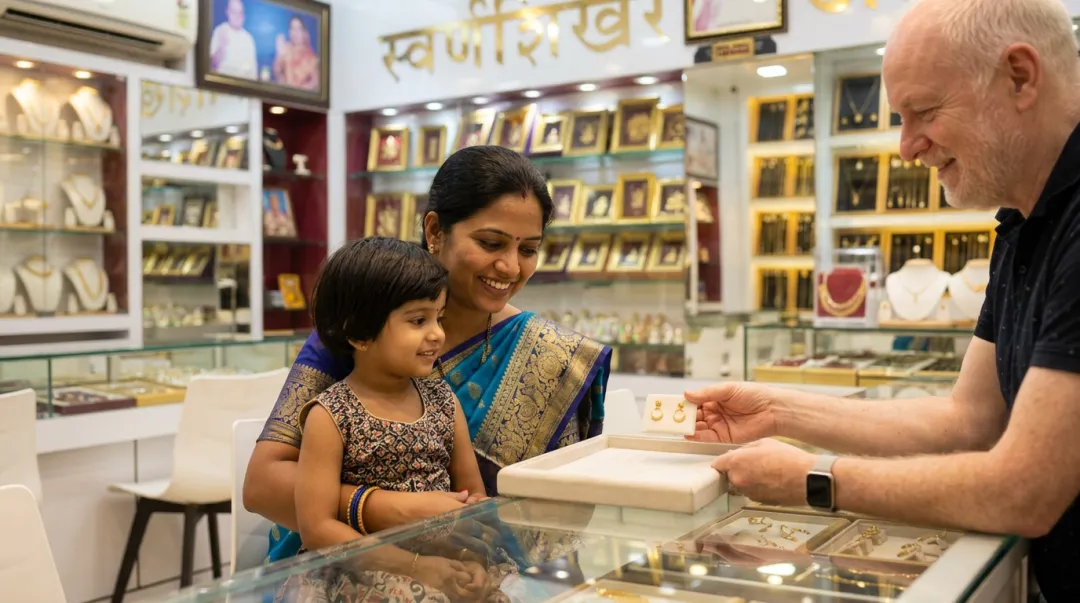
Ear Piercing in Chembur
Single-use sterile cartridges, for children and adults, at our counter on Subhash Nagar. Most people find the waiting worse than the piercing.
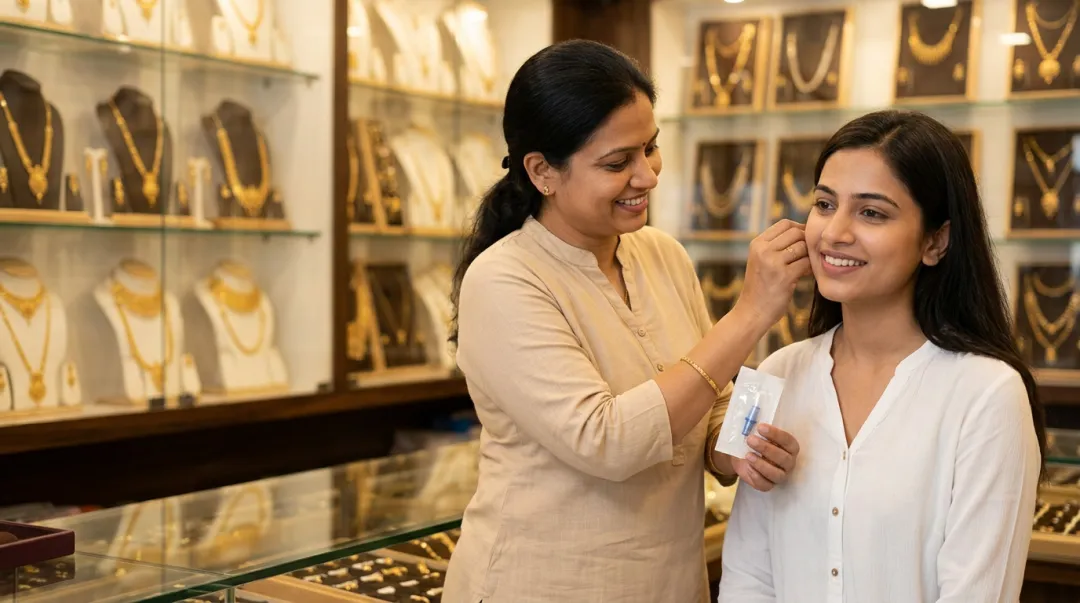
See It Before You Book It
One customer talking about hers, and the procedure itself, filmed at our counter.
What Actually Happens
Four steps, and you can stop at any of them.
Pick the studs first
Gold or medical-grade steel, whichever you prefer. Children usually go with a small plain stud that sits flat and will not catch on clothes or hair.
We mark the spot and you check it
The position is marked on both earlobes and shown to you in a mirror before anything else happens. Nothing goes ahead until you are happy with where it sits.
The cartridge comes out of a sealed pack
The stud sits inside a sealed sterile cartridge that is loaded into the instrument while still in its packet. Nobody's hands touch the stud, and the cartridge is used once and thrown away.
Both ears, a few seconds apart
It is over quickly. Afterwards we go through how to clean it and how long to leave the studs in.
How We Keep It Clean
The equipment matters more than anything else here.
Sealed until the moment it is used
Each stud arrives in its own sterile cartridge. It is opened in front of you, used once, and thrown away.
The cartridge never touches skin
It loads into the instrument while still inside its packet, so neither your skin nor ours makes contact with it. A reusable instrument cannot do that.
Made to FDA and European standards
The studs and the cartridge system are manufactured to United States FDA and EC standards.
Earlobes, for all ages
We pierce earlobes for children and adults. Cartilage higher up the ear is a different job that should be done with a needle, and we will say so rather than take the work.
Karnavedha, If You Are Following the Tradition
A good number of the piercings we do are for a ceremony rather than for fashion.
Karnavedha is one of the sixteen samskaras, the ceremony marking a child's first ear piercing. The name comes from karna, ear, and vedha, to pierce. It is believed to bring the child health and good fortune, and in many families it is the first time the child wears gold.
Families usually pick a date with their priest. Traditionally it falls on the twelfth or sixteenth day after birth, in the sixth to eighth month, or in an odd-numbered year, most often between one and five. Monday, Wednesday, Thursday and Friday are the days generally considered auspicious.
If you are still choosing a date, our Indian festival and muhurat calendar lists the auspicious windows through the year. Tell us it is for Karnavedha when you arrive and we will take our time over it rather than treating it as a two-minute job.
Looking After a New Piercing
Six weeks of small habits, and then you can wear what you like.
Clean twice a day
Warm saline on a clean cotton pad, front and back. Plain water is fine too. Skip the antiseptic creams unless a doctor has told you otherwise.
Leave the studs alone
Do not twist them. The old advice about rotating earrings has been dropped because it disturbs healing tissue. Just clean them and leave them in.
Six weeks before you change them
Earlobes usually settle in about six weeks. Keep the first studs in for that whole time, including at night, or the hole can start to close.
Come back if something looks wrong
A little redness in the first few days is normal. Swelling that gets worse, heat, or discharge is not. Come in and we will look, or see a doctor if it has gone on.
Questions People Ask Us
Mostly about pain, and mostly from parents.
Does ear piercing hurt?
Earlobes have very little nerve tissue, so most people describe it as a sharp pinch that is over before they have finished bracing for it. One customer told us on camera that she could not tell when hers had been done. Children often surprise their parents by not reacting at all.
What age can a baby or child get their ears pierced?
There is no single rule. In the Karnavedha tradition it is commonly done between one and five years, though some families do it much earlier. Practically, the earlobe needs to be developed enough to mark accurately, and the child needs to be able to keep their hands away from it. Come in and we will tell you whether we think it is a good time.
Do you use a gun or a needle?
We use a single-use sterile cartridge system for earlobes. The stud sits in a sealed cartridge that loads into the instrument inside its own packet, so it is never handled and never reused. Cartilage piercing higher up the ear is a different procedure that is better done with a needle, and we will say so rather than take the work.
How long does an ear piercing take to heal?
Earlobes usually heal in around six weeks. Keep the original studs in for that whole period, clean them twice a day with saline, and do not twist them. Cartilage takes considerably longer, often several months.
Can I bring my own earrings for the piercing?
Not for the piercing itself. The first studs have to come from the sterile cartridge, which is what keeps the process clean. Once the piercing has healed at around six weeks you can wear whatever you like, and we can help you pick something from the counter.
What is Karnavedha and do you do it?
Karnavedha is the Hindu ceremony marking a child's first ear piercing, one of the sixteen samskaras. Families often choose a date their priest has picked. We are happy to work to a muhurat, and you can look up auspicious dates on our Indian calendar. Tell us when you arrive that it is for Karnavedha and we will keep it unhurried.
Come In and We Will Talk It Through
Walk in and ask us anything first, including whether today is the right day for it.